
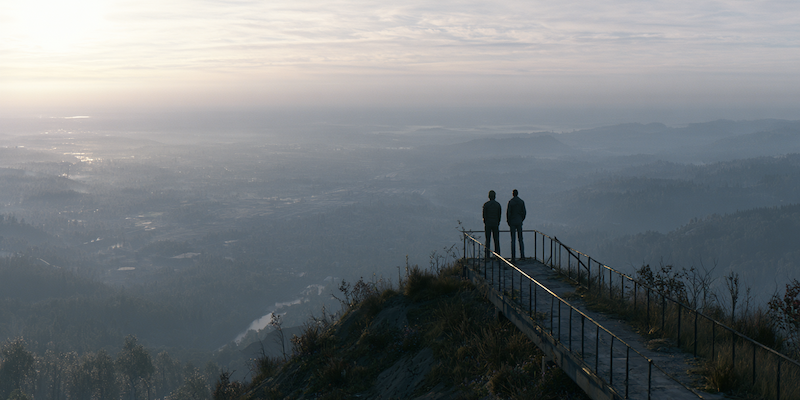
Every coach has blind spots. Not the struggling ones. Every coach. The newly qualified and the deeply experienced alike. This isn’t a problem with their coaching. It’s a problem with vantage points.
You cannot be inside something and outside it at the same time. That’s not a coaching problem. It’s not even a professional problem. It’s just what it means to be human.
Think about the last time you tried to edit your own writing. You read what you intended to say rather than what’s actually there. Your brain fills in the gaps, smooths over the rough edges, confirms what you already believe is on the page. You need another pair of eyes — not because you can’t write, but because you wrote it. The proximity itself is the problem.
Coaching is the same. Except the stakes are higher and the blind spots are harder to find.
When you’re in a coaching session, you are simultaneously the instrument and the observer. You’re making choices — about when to speak, when to stay quiet, which thread to follow, which to leave. You’re reading the client, managing the relationship, tracking the time, holding the contract. All of this at once, in real time, with no opportunity to step back.
And then the session ends. And you have your version of what happened.
That version is always partial. Not wrong, necessarily. But partial. Because it’s the version from inside the room, from inside your particular history, your particular set of assumptions about what coaching is for and what this client needs and what good looks like. Every coach has those assumptions. The question is simply whether you know what yours are.
This is where the most experienced coaches are sometimes the most surprised. Not the newer ones — they expect to have blind spots, they’re still learning. The coaches who find this most confronting are the ones who’ve been doing this for a long time and doing it well. Because competence can make you less curious about what you’re not seeing. When things are working, there’s less incentive to look underneath them.
What becomes clear when you look at how coaches develop over a long career is this: the ones who grow most significantly are not the ones who work the hardest or accumulate the most models or take the most courses. They’re the ones who maintain genuine curiosity about their own practice. Who keep asking — not just what am I doing, but what am I assuming? What am I not noticing? What might someone standing outside this see that I can’t?
That’s what supervision is.
Not an inspection. Not a remedial process for coaches who are struggling. Not something you graduate into when you’ve been coaching long enough. Supervision is the structural response to a structural problem. It exists because of what coaching is — because of the particular demands it places on the person doing it — not because of any deficiency in the people who practice it.
A supervisor is someone trained to hold the view from outside. To look at your practice with you — not instead of you — and to see what the vantage point from inside inevitably obscures. The pattern that’s been present in every session and has therefore become invisible. The assumption that’s been quietly shaping every intervention with a particular client. The thing you’re doing that works beautifully and that you’ve never examined — which means you don’t fully understand it and can’t develop it further.
These aren’t failures. They’re the natural consequence of being a practitioner rather than an observer of your own practice.
Supervision isn’t a correction. It isn’t a signal that something has gone wrong. It’s what serious professional practice looks like in a discipline where you are always, inevitably, working from the inside.
The coaches who find it most valuable are often not the ones who came to it because something was wrong. They’re the ones who came because they were curious. Because they’d reached a point in their practice where they knew enough to know what they didn’t know. Because they wanted the view from outside — not as a verdict on what they’d been doing, but as a resource for what they could become.
That’s what supervision offers. Not a judgment on your coaching. A different vantage point on it.
And once you’ve had that — once you’ve experienced what it is to see your practice from the outside — it’s quite difficult to imagine working without it.

 Learn About our Coaching Supervision Training
 The Complete Guide to Becoming a Coaching Supervisor
 Picturing Coach Supervision: An illustrated Guide
 Course details and dates for our Accredited Diploma in Coaching Supervision
 A self-assessment to gauge your readiness
 A course assessment checklist for reviewing any supervision course